

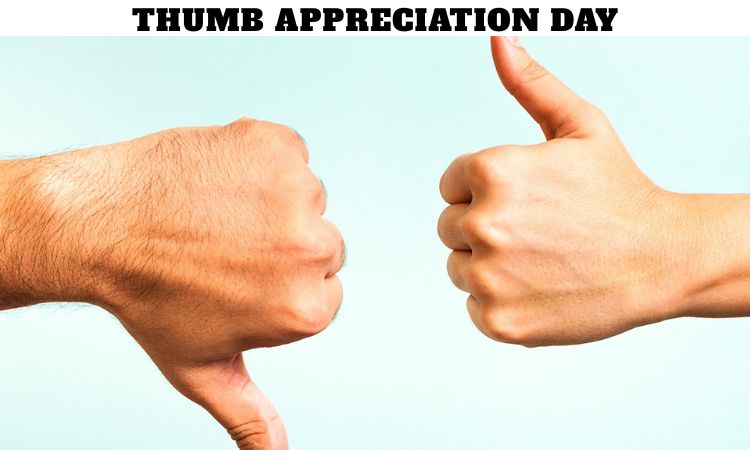
Every year on February 18, people across the United States observe Thumb Appreciation Day, a lighthearted yet meaningful celebration dedicated to one of the most important features of the human body—the thumb. While it may seem like a small part of our anatomy, the thumb plays a monumental role in daily life, communication, productivity, and human evolution.
Thumb Appreciation Day encourages us to recognize how essential our thumbs are for gripping, writing, texting, cooking, creating, and performing countless other tasks. From prehistoric survival tools to modern smartphone screens, the thumb has shaped human civilization in extraordinary ways.
What Is Thumb Appreciation Day?
Thumb Appreciation Day, observed annually on February 18, is a fun observance that highlights the functional importance of the human thumb. Unlike other body parts, the thumb is opposable, meaning it can touch the tips of the other fingers. This simple anatomical feature gives humans unmatched dexterity and control.
The day reminds us that everyday activities—holding a cup of coffee, typing on a keyboard, fastening buttons, or giving a “thumbs up”—would be incredibly difficult without this small but powerful digit.
Why Are Thumbs So Important?
The thumb accounts for nearly 40% of hand function. Its opposable structure allows for precision grips and power grips, which are fundamental to human capability.
Precision Grip
This allows us to hold small objects like a pen, needle, or smartphone stylus. The thumb presses against the index finger to create fine control.
Power Grip
This grip is used when holding heavier objects such as tools, sports equipment, or weights. The thumb wraps around and stabilizes the object.
Without the thumb’s unique range of motion, many of our daily tasks would require significantly more effort or would not be possible at all.
The Science Behind the Opposable Thumb
The human thumb is structurally distinct from the other four fingers. It contains:
Two phalanges (bones), instead of three
A specialized saddle joint at the base
Strong muscles in the thenar region of the palm
These anatomical features provide flexibility, rotation, and strength. The saddle joint allows the thumb to rotate across the palm, enabling opposition—a movement that is rare in the animal kingdom.
How Did Thumbs Influence Human Evolution?
The opposable thumb played a vital role in human evolution. Early humans used their thumbs to:
Create stone tools
Hunt and prepare food
Build shelters
Craft weapons
The ability to manipulate tools contributed to survival, innovation, and brain development. Over thousands of years, this dexterity allowed humans to dominate environments and develop complex societies.
Anthropologists believe that the evolution of the thumb directly influenced technological advancement, from primitive tools to modern machinery.
Thumbs in Modern Technology
In today’s digital age, thumbs are more important than ever. The rise of smartphones has given birth to the term “thumb typing,” referring to texting or typing using only thumbs.
Consider how often we use our thumbs to:
Scroll through social media
Send messages
Play video games
Navigate apps
Unlock devices with biometric sensors
Modern technology is designed with thumb accessibility in mind. Touchscreen interfaces, controller designs, and gaming consoles all account for thumb ergonomics.
The Cultural Meaning of the Thumbs-Up Gesture
One of the most recognizable gestures worldwide is the thumbs-up sign. It generally symbolizes approval, positivity, or agreement. While interpretations can vary across cultures, it has become universally associated with encouragement and affirmation.
Social media platforms even use the thumbs-up icon as a symbol of “liking” content, reinforcing its cultural significance in digital communication.
Thumb-Related Professions and Activities
Many careers and hobbies rely heavily on thumb dexterity:
Musicians
Guitarists, pianists, and violinists depend on thumb strength and flexibility for precision.
Surgeons
Medical professionals require steady thumb control for delicate procedures.
Artists and Designers
Painters and sculptors rely on fine thumb movements for detailed craftsmanship.
Athletes
Sports such as basketball, tennis, and rock climbing demand strong thumb grip and coordination.
Thumb Appreciation Day highlights how these professions would be nearly impossible without optimal thumb function.
Common Thumb Injuries and Conditions
While thumbs are strong, they are also vulnerable to injury and strain.
Sprains and Fractures
Often caused by sports accidents or falls.
Trigger Thumb
A condition where the thumb becomes locked in a bent position.
Arthritis
The thumb joint is a common site for osteoarthritis due to frequent use.
Texting Thumb
Overuse of smartphone activity can cause pain and inflammation.
Taking care of thumb health ensures long-term mobility and functionality.
How to Celebrate Thumb Appreciation Day?
Celebrating Thumb Appreciation Day can be both fun and practical. Here are some meaningful ideas:
1. Practice Thumb Exercises
Strengthen and stretch your thumbs to maintain flexibility and prevent injury.
2. Give Your Thumbs a Break
Limit excessive phone usage and repetitive movements.
3. Learn a New Skill
Try knitting, playing a musical instrument, or drawing—activities that challenge thumb coordination.
4. Share a Thumbs-Up Gesture
Spread positivity by using the iconic gesture to encourage others.
5. Reflect on Accessibility
Recognize individuals who rely on adaptive devices and technologies when thumb mobility is limited.
Thumbs in the Animal Kingdom
While humans have highly developed opposable thumbs, some primates also possess similar adaptations. Chimpanzees and gorillas use their thumbs for climbing and tool use. However, human thumbs provide a greater range of motion and precision, setting us apart in terms of fine motor skills.
This evolutionary distinction underscores the thumb’s importance in shaping human civilization.
Thumbs and Communication in the Digital Era
The modern world increasingly depends on thumb-based communication. Messaging apps, gaming, and social platforms rely heavily on thumb input. Emojis and reaction icons—particularly the thumbs-up symbol—have become universal tools of digital expression.
The thumb now represents connection in an age driven by instant interaction.
Fun Facts About Thumbs
The thumb is responsible for about half of the hand’s workload.
Humans can rotate their thumbs more freely than most primates.
Thumbprints are unique, just like fingerprints.
The average person uses their thumbs thousands of times per day while texting.
These facts demonstrate how integral thumbs are to everyday life.
The Psychological Symbolism of the Thumb
The thumbs-up sign often symbolizes confidence and success. In many cultures, it conveys reassurance and solidarity. Its positive connotation has made it one of the most widely recognized gestures globally.
Thumb Appreciation Day invites us to recognize not only physical function but also symbolic power.
Ergonomics and Thumb Health
As digital device usage increases, protecting thumb health becomes essential. Here are some tips:
Use ergonomic phone grips
Take regular breaks from typing
Perform stretching exercises
Avoid prolonged repetitive motion
Maintaining proper hand posture can prevent strain and long-term discomfort.
Why February 18 Is the Perfect Day to Celebrate?
February often falls during colder months when hands can feel stiff or dry. Thumb Appreciation Day provides a reminder to care for our hands during this season. Moisturizing skin, stretching joints, and acknowledging daily hand use become timely practices.
This day also adds a touch of humor and gratitude to the calendar, encouraging awareness of something we often take for granted.
The Future of Thumb Technology
Advancements in wearable technology, virtual reality controllers, and robotics continue to rely on thumb precision. Engineers design devices that replicate or enhance thumb functionality, including prosthetics with advanced movement capabilities.
Artificial intelligence and robotics research aim to replicate human thumb dexterity—an ongoing challenge due to its complexity. This further proves how remarkable the human thumb truly is.
Conclusion: Appreciating the Smallest Yet Strongest Contributor
Thumb Appreciation Day on February 18 celebrates one of the most powerful tools in the human body. Though small in size, the thumb has shaped history, influenced evolution, and enabled modern technology. From early tool-making to smartphone navigation, it remains central to human progress.