

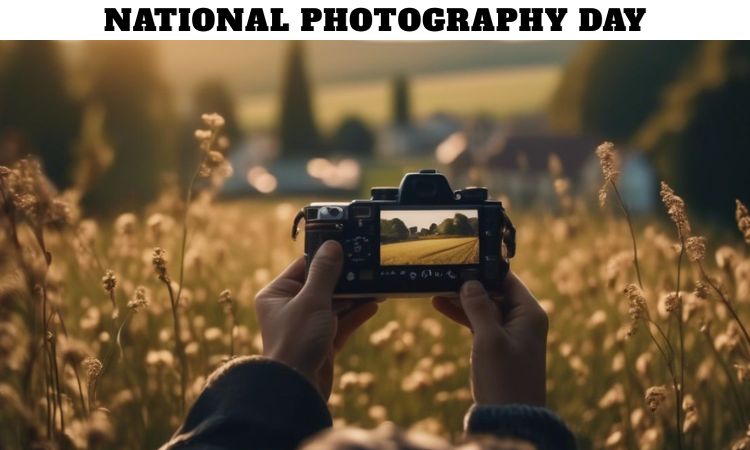
National Photography Day is celebrated every year on August 19 as a tribute to the art, science, creativity, and technology of photography. Photographs have become an important part of everyday life, allowing people to capture moments, preserve memories, document events, express creativity, and tell stories without using words.
From family portraits and travel photographs to journalism, wildlife photography, fashion shoots, and images captured on smartphones, photography is now accessible to almost everyone. A single photograph can preserve a moment that may otherwise disappear with time.
National Photography Day provides an opportunity to appreciate photographers, explore the history of photography, learn about different photographic techniques, and recognize how images influence the way people understand the world.
Why Is National Photography Day Celebrated on August 19?
National Photography Day is observed on August 19 to recognize the development and influence of photography and to encourage people to appreciate the art of capturing images. The date is also associated with an important milestone in photographic history: the announcement of the daguerreotype process in 1839.
The daguerreotype was one of the earliest successful photographic processes and was developed by French artist and inventor Louis Daguerre. The process made it possible to create detailed photographic images on silver-coated copper plates.
The development of photography changed how people recorded people, places, events, and everyday life. Before photography became practical, memories and important individuals were primarily represented through paintings, drawings, and written descriptions.
Photography introduced a new way of preserving reality, eventually transforming communication, journalism, science, art, advertising, and personal life.
What Is the History Behind National Photography Day?
The history of photography stretches back much further than the invention of the modern digital camera. Early experiments with cameras and light eventually led to techniques that could permanently record images.
In the 19th century, inventors and scientists worked on methods for producing photographs that could be preserved. Joseph Nicéphore Niépce created one of the earliest known surviving permanent photographs in the 1820s. His experiments later influenced the development of the daguerreotype process.
Louis Daguerre improved photographic techniques and introduced the daguerreotype, which became publicly known in 1839. The process produced highly detailed images, although each photograph required a carefully prepared metal plate and could not easily be reproduced like modern photographs.
Photography continued to evolve through the introduction of glass plates, film, portable cameras, color photography, instant photography, and eventually digital imaging.
Today, people can take photographs instantly using smartphones. This transformation has made photography a universal form of communication.
How Has Photography Changed Over the Years?
Photography has undergone remarkable changes since its early days. Early photographers needed specialized equipment, careful preparation, and considerable technical knowledge. Taking a photograph could be a complicated and time-consuming process.
The development of photographic film made cameras more practical and accessible. Portable cameras allowed people to take photographs outside professional studios. Later, automatic cameras made photography easier for beginners.
The arrival of digital photography represented another major transformation. Digital cameras eliminated the need for traditional photographic film and allowed users to immediately review their pictures.
Smartphones have taken accessibility even further. Modern phones can produce high-quality photographs, apply advanced processing, remove unwanted elements, improve lighting, and share images instantly.
Photography has therefore moved from a specialized technical practice to an everyday activity enjoyed by billions of people around the world.
Why Is Photography Important in Everyday Life?
Photography is important because it allows people to preserve moments and memories. Birthdays, weddings, vacations, family gatherings, festivals, achievements, and ordinary moments can all become lasting memories through photographs.
Pictures can also help people remember details that might otherwise fade over time. An old photograph can bring back memories of a particular person, place, event, or period in someone’s life.
Photography also plays an important role in communication. News organizations use photographs to explain events, businesses use images to present their products, and individuals use photographs to share experiences through social media.
In many situations, an image can communicate information faster than a long written explanation.
How Does Photography Help Preserve History?
Photography is one of the most valuable tools for documenting history. Photographs can provide visual records of people, buildings, landscapes, conflicts, cultural traditions, technological developments, and major events.
Historical photographs allow future generations to see how cities, communities, clothing, transportation, architecture, and everyday life changed over time.
Photojournalists have also played an important role in documenting significant events. Their work can bring distant events to audiences around the world and create visual records that remain important long after an event has ended.
Family photographs also contribute to history on a smaller scale. Personal collections can show how families lived, celebrated traditions, traveled, worked, and interacted across generations.
What Are the Different Types of Photography?
Photography has many different forms, and photographers often specialize in particular subjects or styles.
- Portrait photography focuses on people and attempts to capture personality, expression, and emotion.
- Landscape photography captures natural environments, mountains, forests, oceans, deserts, and other scenic locations.
- Wildlife photography focuses on animals and their natural surroundings, often requiring patience and specialized equipment.
- Street photography documents everyday life and spontaneous moments in public places.
- Fashion photography is used to showcase clothing, accessories, models, and creative concepts.
- Sports photography captures fast-moving action and important moments during athletic competitions.
- Other forms include food photography, architectural photography, travel photography, product photography, macro photography, astrophotography, documentary photography, and photojournalism.
The variety of photographic styles demonstrates how flexible and creative the medium can be.
How Can People Celebrate National Photography Day?
There are many simple ways to celebrate National Photography Day. People do not need expensive cameras or professional equipment to participate.
One of the easiest ways is to take photographs of everyday moments. A walk through a neighborhood, a sunrise, a favorite meal, a pet, or time spent with family can become an interesting photographic subject.
People can also revisit old photographs and organize their digital albums. Printing a few meaningful photographs is another way to preserve memories beyond digital storage.
Photography enthusiasts can experiment with different techniques, such as changing composition, using natural light, photographing reflections, trying close-up photography, or capturing movement.
Another idea is to visit a photography exhibition, learn about famous photographers, or watch educational material about photography. Beginners can also participate in photography challenges and share their favorite photographs with friends.
Can You Celebrate National Photography Day With a Smartphone?
Absolutely. A smartphone is enough to celebrate National Photography Day.
Modern smartphones provide cameras capable of capturing detailed photographs in a wide range of conditions. Many also include portrait modes, wide-angle lenses, night photography, slow-motion video, and computational photography features.
Instead of concentrating only on camera equipment, beginners can focus on basic photographic principles. Composition, lighting, perspective, timing, and subject selection often have a greater impact on the final photograph than expensive equipment alone.
Trying to capture the same subject from several different angles can also help photographers understand how perspective changes an image.
National Photography Day can therefore be enjoyed by anyone, regardless of their experience or equipment.
What Makes a Photograph Meaningful?
A meaningful photograph does not necessarily have to be technically perfect. Sometimes the most valuable photographs are those that capture genuine emotions, important memories, or unique moments.
A photograph of a family member may become more valuable as the years pass. A picture from a memorable journey can bring back the atmosphere of a particular place. A simple photograph of childhood friends can become an important reminder of an earlier stage of life.
Good photography combines technical elements with storytelling. A strong photograph can make viewers curious, emotional, nostalgic, surprised, or inspired.
This is one reason photography continues to remain powerful even as technology changes.
How Has Social Media Changed Photography?
Social media has dramatically increased the number of photographs people create and share. Platforms centered around visual content have turned photography into a major form of online communication.
People now use photographs to document vacations, food, fashion, celebrations, hobbies, professional achievements, and daily experiences. Businesses also depend heavily on photography for marketing and branding.
Social media has created opportunities for amateur photographers to reach large audiences without depending on traditional publishers or galleries.
At the same time, the enormous volume of online images has made originality and authenticity increasingly important. Photographers are constantly experimenting with new perspectives, editing techniques, storytelling methods, and visual styles.
Why Should Children Learn About Photography?
Photography can be a useful creative activity for children because it encourages observation and curiosity. Taking photographs encourages young people to pay attention to details that they might normally overlook.
Photography can also teach basic concepts such as composition, light, color, perspective, patience, and storytelling.
Children can start with simple subjects around their homes or neighborhoods. They can photograph plants, pets, toys, buildings, shadows, clouds, or family activities.
Photography can also encourage children to think creatively about how they communicate ideas through images.
What Can We Learn From National Photography Day?
National Photography Day reminds us that photographs are more than digital files stored on phones and computers. They are records of experiences, emotions, people, places, and history.
The day encourages people to slow down and notice the world around them. It also highlights the creativity involved in transforming an ordinary scene into an interesting image.
Photography teaches us that important moments can happen anywhere. A professional studio is not required to create a meaningful photograph. Sometimes the most memorable images come from ordinary situations captured at exactly the right moment.
As technology continues to develop, photography will likely become even more sophisticated. Artificial intelligence, computational photography, high-resolution cameras, and advanced editing tools are already changing how images are created.
Despite these technological developments, the basic purpose of photography remains the same: to capture and preserve moments that matter.
How Can You Make National Photography Day Special?
You can make August 19 special by creating a small photography project. Choose a theme such as nature, family, architecture, food, pets, or local life and capture several photographs throughout the day.
You could also create a photo album featuring your favorite memories from the past year. Another meaningful activity is to photograph an older family member and record their stories alongside the pictures.
If you enjoy photography, August 19 can also be an opportunity to learn something new. Experiment with manual camera settings, natural lighting, composition, black-and-white photography, or a new editing technique.
Most importantly, National Photography Day is about appreciating the ability to preserve moments visually. Whether captured with a professional camera or a smartphone, photographs can become valuable memories for years to come.
Frequently Asked Questions (FAQs)
1. When is National Photography Day celebrated?
National Photography Day is celebrated annually on August 19.
2. What is National Photography Day?
National Photography Day is an occasion that celebrates photography as an art, creative activity, communication tool, and method of preserving memories and history.
3. Why is August 19 associated with photography?
August 19 is associated with the history of photography because the daguerreotype photographic process was publicly announced in 1839, marking an important moment in the development of practical photography.
4. Who invented photography?
Photography developed through the work of several inventors and scientists. Joseph Nicéphore Niépce produced one of the earliest surviving permanent photographs, while Louis Daguerre developed and publicly introduced the daguerreotype process.
5. Can I celebrate National Photography Day with a phone?
Yes. A smartphone camera is more than enough to celebrate National Photography Day. You can photograph people, nature, architecture, food, pets, or everyday moments.
6. What is the purpose of National Photography Day?
The purpose is to appreciate photography, recognize its historical and cultural importance, encourage creativity, and celebrate the people who use photography to document and communicate the world.
7. What are the most popular types of photography?
Popular types include portrait, landscape, wildlife, travel, street, fashion, sports, food, architectural, macro, documentary, and nature photography.
8. How can beginners celebrate National Photography Day?
Beginners can take photographs around their homes or communities, experiment with composition and lighting, participate in a photography challenge, organize old photographs, or learn basic photography techniques.
9. Why is photography important?
Photography helps preserve memories, document history, communicate information, express creativity, and tell stories visually.
10. Is National Photography Day the same as World Photography Day?
The terms are sometimes used interchangeably in online discussions, although different organizations and communities may use different names when promoting August 19 photography celebrations. August 19 is widely associated with the history of the daguerreotype and photography.