

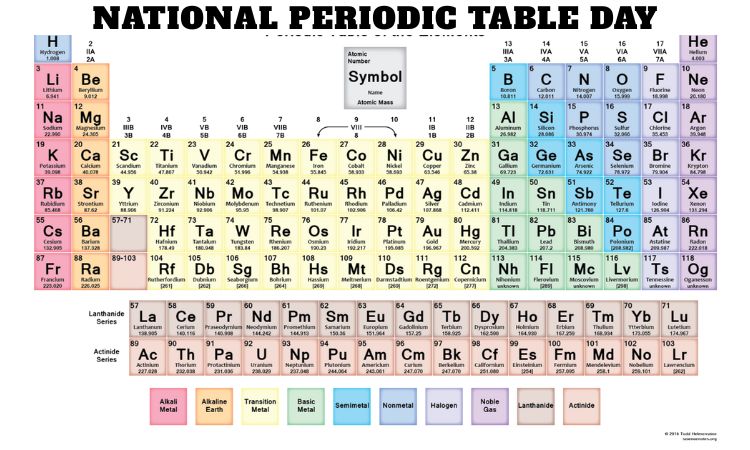
What Is National Periodic Table Day, and Why Is It Celebrated on February 7?
National Periodic Table Day, observed every year on February 7, is a celebration of one of the most important scientific tools ever created—the Periodic Table of Elements. This day honors the systematic arrangement of chemical elements that has transformed our understanding of matter, energy, and the natural world. We celebrate National Periodic Table Day to recognize its role in education, scientific discovery, and technological advancement.
The date, February 7, corresponds to the publication of the first modern periodic table by Dmitri Mendeleev in 1869. His groundbreaking work provided a framework that allowed scientists to predict the properties of elements yet to be discovered, revolutionizing chemistry and related sciences.
Who Created the Periodic Table and What Inspired Its Development?
The periodic table was created by Dmitri Mendeleev, a Russian chemist who sought to organize known elements in a logical and predictive manner. By arranging elements according to atomic weight and chemical properties, he noticed repeating patterns that formed the foundation of the periodic law.
We recognize Mendeleev’s genius not only for organizing existing knowledge but also for leaving gaps for undiscovered elements. His predictions were later confirmed, validating the power of the periodic table as a scientific model.
Why Is the Periodic Table Considered a Cornerstone of Modern Science?
The periodic table is considered a cornerstone of science because it provides a unified framework for understanding chemical behavior. It reveals relationships among elements, enabling scientists to predict reactions, design experiments, and develop new materials.
We rely on the periodic table across disciplines, including chemistry, physics, biology, medicine, and engineering. Its structure simplifies complex information, making it accessible to students and professionals alike.
How Does the Periodic Table Organize Chemical Elements?
The periodic table organizes elements based on atomic number, electron configuration, and recurring chemical properties. Elements are arranged in rows called periods and columns known as groups or families.
We appreciate how this organization highlights trends such as atomic size, electronegativity, and reactivity. These patterns allow for deeper understanding of how elements interact and why they behave as they do.
What Are Periods and Groups in the Periodic Table?
Periods are horizontal rows that indicate the number of electron shells an element has, while groups are vertical columns that share similar chemical properties. For example, noble gases form a group known for stability, while alkali metals are highly reactive.
We emphasize that understanding periods and groups helps learners quickly grasp elemental behavior, making the periodic table an essential educational tool.
Why Are Element Symbols Important in the Periodic Table?
Each element is represented by a chemical symbol, usually derived from Latin or Greek names. These symbols provide a universal language for scientists worldwide, ensuring clarity and consistency in communication.
We recognize that these symbols simplify complex chemical equations and allow for efficient representation of substances and reactions.
How Has the Periodic Table Evolved?
Since its creation, the periodic table has evolved with scientific advancements. New elements have been discovered and added, and atomic number replaced atomic weight as the organizing principle.
We acknowledge that this evolution reflects the dynamic nature of science. The modern periodic table continues to adapt as researchers explore synthetic and superheavy elements.
What Role Does the Periodic Table Play in Education?
The periodic table is a foundational learning tool in science education. It introduces students to elemental properties, chemical relationships, and scientific reasoning.
We value its role in fostering curiosity and critical thinking. By studying the periodic table, students gain a structured understanding of matter that supports advanced scientific learning.
How Does the Periodic Table Influence Everyday Life?
Elements from the periodic table are present in nearly every aspect of daily life—from oxygen we breathe to silicon in electronics and iron in construction.
We recognize that the periodic table underpins technologies such as smartphones, medical devices, and renewable energy systems. Its influence extends far beyond classrooms and laboratories.
Why Is the Periodic Table Essential to Medical and Technological Advancements?
Medical treatments and technologies rely heavily on elements and their compounds. Elements like iodine, calcium, and platinum play critical roles in diagnostics, therapies, and medical equipment.
We appreciate how the periodic table guides innovation in pharmaceuticals, materials science, and biotechnology, enabling breakthroughs that improve quality of life.
How Does the Periodic Table Help Predict Chemical Reactions?
The periodic table allows scientists to anticipate how elements will interact based on their position and properties. This predictive power is essential for chemical synthesis and industrial processes.
We rely on these predictions to develop safer materials, optimize reactions, and advance sustainable practices.
What Are Some Fascinating Facts About the Periodic Table?
The periodic table contains both naturally occurring and synthetic elements. Some elements exist for only fractions of a second, while others have been known since ancient times.
We find fascination in how the table connects the microscopic world of atoms with the macroscopic world of materials and energy.
How Is National Periodic Table Day Celebrated?
National Periodic Table Day is celebrated through educational events, classroom activities, and public science outreach. Students and educators engage in experiments, quizzes, and discussions centered on elemental science.
We encourage participation that promotes learning and appreciation for scientific discovery, making the day both informative and inspiring.
Why Is February 7 Significant to the History of the Periodic Table?
February 7 marks the date when Mendeleev first presented his periodic system. This moment changed the trajectory of chemical science and provided a universal framework still used today.
We honor this milestone as a testament to human curiosity and intellectual achievement.
How Does the Periodic Table Support Future Scientific Discoveries?
The periodic table continues to guide research into new elements and materials. Scientists use it to explore unknown properties and develop innovative applications.
We see it as a living document that evolves alongside scientific progress, supporting discoveries that shape the future.
Why Does the Periodic Table Unite Science Across Disciplines?
The periodic table serves as a common reference point for multiple scientific fields. Its universal structure fosters collaboration and shared understanding.
We value this unifying role, as it bridges disciplines and encourages interdisciplinary innovation.
What Makes the Periodic Table a Timeless Scientific Achievement?
The periodic table endures because it combines simplicity with profound insight. It organizes complex information into a coherent and predictive system.
We conclude that its timelessness lies in its ability to adapt, educate, and inspire, making it a lasting symbol of scientific progress.
Why Should National Periodic Table Day Be Celebrated Every Year?
National Periodic Table Day deserves annual recognition because it celebrates knowledge, discovery, and the power of scientific organization. It honors a tool that continues to shape our understanding of the universe.