

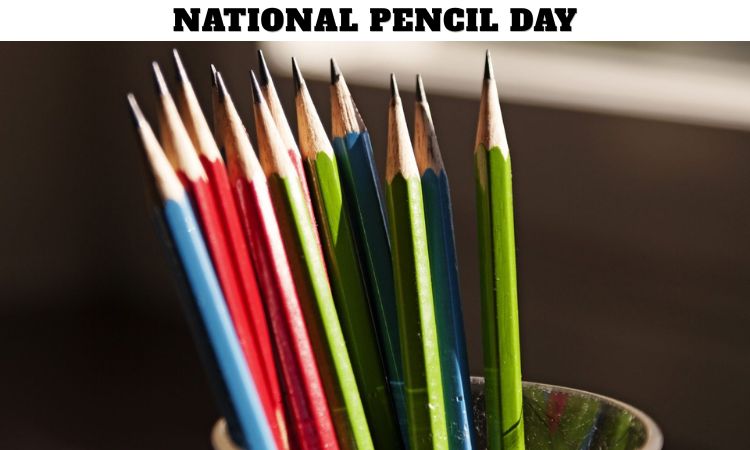
National Pencil Day, observed annually on March 30, commemorates the invention and enduring significance of one of the simplest yet most powerful tools ever created—the pencil. This day marks the anniversary of the 1858 patent granted to Hymen Lipman for attaching an eraser to a pencil, a revolutionary innovation that transformed writing and drawing forever.
We recognize National Pencil Day as a tribute to creativity, education, and innovation. From classrooms to art studios, pencils have played a fundamental role in shaping ideas, recording history, and enabling artistic expression.
The History of the Pencil
Early Beginnings of Writing Tools
Before the invention of pencils, people used various tools such as:
- Charcoal sticks
- Quill pens
- Metal styluses
The discovery of graphite in the 16th century in Borrowdale marked a turning point. Graphite was initially mistaken for lead, which is why pencils were often referred to as “lead pencils.”
Development of the Modern Pencil
The modern pencil evolved when graphite was encased in wooden holders, making it easier to use and transport. Over time, improvements in design and manufacturing led to:
- Standardized shapes
- Different hardness levels
- Mass production
The addition of an eraser by Hymen Lipman further enhanced its functionality, making pencils an essential everyday tool.
Why National Pencil Day is Important?
Celebrating Innovation
The pencil represents a perfect blend of simplicity and innovation. It is a tool that has:
- Empowered education
- Supported creativity
- Enabled communication
We emphasize that pencils have been instrumental in shaping human progress and knowledge sharing.
Encouraging Creativity and Learning
Pencils are often the first tools children use to learn writing and drawing. They help develop:
- Fine motor skills
- Hand-eye coordination
- Creative thinking
National Pencil Day reminds us of the importance of basic tools in building foundational skills.
Types of Pencils and Their Uses
Graphite Pencils
Graphite pencils are the most common type, used for writing and sketching. They come in different grades such as:
- H (Hard) for light lines
- B (Black) for darker strokes
- HB for general writing
Colored Pencils
Colored pencils are widely used in art and design. They allow for:
- Detailed coloring
- Layering techniques
- Creative expression
Mechanical Pencils
Mechanical pencils use refillable graphite leads and offer precision. They are ideal for:
- Technical drawing
- Professional work
- Clean and consistent lines
Specialty Pencils
Other types include:
- Charcoal pencils
- Watercolor pencils
- Carpenter pencils
Each type serves a unique purpose, highlighting the versatility of pencils.
The Role of Pencils in Education
We acknowledge that pencils are a cornerstone of education worldwide. They are:
- Affordable and accessible
- Easy to use and correct
- Essential for learning writing skills
Students rely on pencils for:
- Note-taking
- Exams
- Creative assignments
The ability to erase mistakes encourages learning through trial and error, which is crucial for development.
Pencils in Art and Design
A Tool for Artists
Pencils are indispensable for artists. They are used for:
- Sketching initial ideas
- Creating detailed drawings
- Shading and texture work
Versatility in Artistic Expression
Artists prefer pencils because they offer:
- Control over line quality
- Flexibility in shading
- Ease of correction
We highlight that many masterpieces begin with a simple pencil sketch, proving its fundamental role in artistic creation.
Environmental Impact and Sustainability
Eco-Friendly Nature of Pencils
Pencils are considered environmentally friendly because:
- They are made from natural materials like wood and graphite
- They have a long lifespan
- They produce minimal waste
Sustainable Manufacturing
Modern manufacturers focus on:
- Using responsibly sourced wood
- Recycling materials
- Reducing environmental impact
We encourage the use of sustainable pencils to support eco-conscious practices.
How to Celebrate National Pencil Day?
1. Use a Pencil for Writing
Take a break from digital devices and write with a pencil. This simple act reconnects us with traditional methods of communication.
2. Create Art
Draw, sketch, or doodle to celebrate creativity. Even simple drawings can be a meaningful way to honor the pencil.
3. Learn About Pencil History
Explore the evolution of pencils and appreciate their role in human development.
4. Gift Pencils
Share the joy of pencils by gifting them to students, artists, or colleagues.
5. Support Sustainable Brands
Choose eco-friendly pencils to contribute to environmental conservation.
Interesting Facts About Pencils
- A standard pencil can write approximately 45,000 words.
- Graphite is not made of lead, despite the common name “lead pencil.”
- The average pencil can draw a line about 35 miles long.
- Pencils can be used in extreme conditions, including space.
These facts highlight the durability and efficiency of this simple tool.
The Future of Pencils in a Digital World
Despite the rise of digital technology, pencils continue to hold their relevance. They are:
- Reliable and accessible
- Free from technical issues
- Preferred for brainstorming and creativity
We observe that pencils remain an essential part of human expression and learning, even in a digital age.
Conclusion
National Pencil Day on March 30 celebrates a tool that has shaped education, creativity, and communication for centuries. From its humble beginnings to its modern variations, the pencil remains a symbol of innovation, simplicity, and endless possibility.
Frequently Asked Questions (FAQs)
1. What is National Pencil Day?
National Pencil Day is celebrated on March 30 to honor the invention and importance of pencils.
2. Why is March 30 important for pencils?
It marks the anniversary of the patent for the pencil with an eraser by Hymen Lipman in 1858.
3. What are pencils made of?
Pencils are made of graphite encased in wood, along with other materials depending on the type.
4. Are pencils made of lead?
No, pencils contain graphite, not lead.
5. What are the different types of pencils?
Types include graphite, colored, mechanical, and specialty pencils.
6. Why are pencils important in education?
They help in writing, drawing, and learning while allowing easy correction of mistakes.
7. How long can a pencil write?
A standard pencil can write around 45,000 words.
8. Are pencils environmentally friendly?
Yes, especially when made from sustainably sourced materials.
9. How can I celebrate National Pencil Day?
You can write, draw, learn about pencils, or gift them to others.
10. Are pencils still relevant today?
Yes, they remain widely used for writing, drawing, and creative work.