
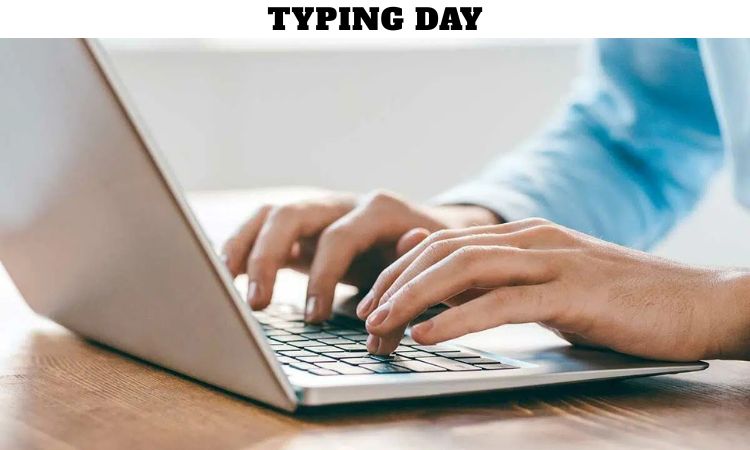
Typing Day, celebrated annually on January 8, is a special observance dedicated to recognizing the importance of typing as a fundamental life and professional skill. In today’s digital-first world, typing is no longer limited to secretarial work or office environments. It is a core competency that powers communication, education, business, creativity, and global connectivity. From emails and reports to coding, content creation, and instant messaging, typing plays a central role in modern life.
We observe Typing Day to appreciate the evolution of typing, honor those who rely on this skill daily, and encourage individuals to improve their typing speed, accuracy, and efficiency.
The Historical Origins of Typing Day
Typing Day has its roots in the history of the typewriter, a revolutionary invention that transformed written communication. The modern typewriter layout, known as the QWERTY keyboard, was developed in the late 19th century to improve mechanical efficiency and reduce key jams. Over time, this layout became the global standard and remains dominant even in today’s digital keyboards.
Typing Day is believed to be associated with the birth anniversary of Christopher Latham Sholes, one of the inventors of the typewriter and the QWERTY keyboard. Celebrated on January 8, this day honors his contribution and the lasting impact of typing on communication and productivity.
Why Typing Matters More Than Ever?
In the digital age, typing is essential across industries and age groups.
Professional Communication
Emails, reports, proposals, and presentations rely heavily on typing. Efficient typing improves workplace productivity and professionalism.
Education and Learning
Students depend on typing for assignments, research, exams, and online learning. Typing proficiency enhances academic performance and digital literacy.
Creative Expression
Writers, journalists, bloggers, and content creators use typing to transform ideas into impactful narratives. Typing enables creativity at scale.
Technology and Innovation
Programmers, developers, and engineers rely on typing to build software, applications, and digital infrastructure.
Typing Day highlights how this seemingly simple skill underpins nearly every aspect of modern society.
The Evolution from Typewriters to Digital Keyboards
Typing has evolved dramatically over the past century.
The Typewriter Era
Early typewriters required significant physical effort and precision. Typists were trained professionals, often working in offices as stenographers or clerks.
The Computer Revolution
With the rise of personal computers in the late 20th century, typing became accessible to the general public. Keyboards became more ergonomic, and typing entered homes, schools, and workplaces.
Mobile and Touchscreen Typing
Today, typing extends beyond physical keyboards to smartphones, tablets, and virtual interfaces. Predictive text, voice-to-text, and swipe typing have expanded how we interact with devices.
Typing Day celebrates this evolution and the adaptability of typing across technologies.
Benefits of Good Typing Skills
Increased Productivity
Fast and accurate typing saves time, allowing individuals to focus on thinking and problem-solving rather than mechanical input.
Improved Accuracy
Proper typing techniques reduce errors, enhancing clarity and professionalism in written communication.
Better Focus and Flow
When typing becomes second nature, thoughts flow more freely, supporting creativity and efficiency.
Career Advancement
Typing proficiency is a valuable skill in nearly every profession, from administration and journalism to IT and marketing.
Touch Typing: The Gold Standard
Touch typing refers to typing without looking at the keyboard, using all fingers efficiently. This method is widely regarded as the most effective and sustainable typing technique.
Key Advantages of Touch Typing
Faster typing speeds
Reduced eye strain
Improved posture
Lower risk of repetitive strain injuries
Typing Day encourages individuals to learn or refine touch typing skills as a long-term investment in productivity and health.
Typing and Ergonomics
Typing is a repetitive activity, making ergonomics essential.
Proper Posture
Maintaining an upright posture with relaxed shoulders reduces strain on the neck and back.
Keyboard Placement
Keyboards should be positioned at elbow height, with wrists kept straight to prevent injury.
Regular Breaks
Short breaks help prevent fatigue and repetitive strain injuries, especially during long typing sessions.
Typing Day promotes awareness of ergonomic practices to support long-term well-being.
Typing in the Workplace
Typing remains a cornerstone of modern workplaces.
Administrative and Office Roles
Administrative professionals rely on typing for documentation, scheduling, and communication.
Remote Work and Digital Collaboration
With the rise of remote work, typing has become even more critical for virtual meetings, collaboration tools, and online communication.
Data Entry and Analysis
Accurate typing ensures data integrity, which is vital for decision-making and reporting.
Typing as a Life Skill for Students
Typing education is increasingly recognized as essential in schools.
Early Skill Development
Introducing typing at a young age builds confidence and digital competence.
Academic Efficiency
Students who type efficiently complete assignments faster and with greater accuracy.
Preparation for Future Careers
Typing skills prepare students for higher education and technology-driven careers.
Typing Day reinforces the importance of integrating typing education into learning systems.
Typing Speed vs. Typing Accuracy
While speed often receives attention, accuracy is equally important.
High accuracy reduces the need for editing
Clear communication prevents misunderstandings
Professional writing depends on precision
Typing Day emphasizes a balanced approach that values both speed and accuracy.
Typing in the Age of Artificial Intelligence
Despite advancements in voice recognition and AI tools, typing remains indispensable.
Typing offers privacy in shared environments
It allows precise control over language
Many tasks require detailed text input
Typing continues to coexist with emerging technologies, adapting rather than becoming obsolete.
How to Celebrate Typing Day?
Practice and Improve
Use Typing Day as an opportunity to practice typing drills or take a typing test to assess progress.
Learn Proper Techniques
Explore touch typing tutorials or courses to refine technique and posture.
Encourage Typing Education
Support typing programs in schools or workplaces to promote digital literacy.
Acknowledge Typing Professionals
Recognize writers, editors, coders, and administrative professionals whose work depends heavily on typing.
The Cultural Impact of Typing
Typing has shaped communication styles, language evolution, and workplace norms. Abbreviations, emojis, and digital expressions have emerged from typed communication, influencing modern language.
Typing Day acknowledges this cultural shift and the role of typing in shaping contemporary interaction.
Conclusion: Honoring Typing on January 8
Typing Day on January 8 celebrates a skill that connects people, powers technology, and drives progress. It honors the journey from mechanical typewriters to digital keyboards and recognizes typing as a cornerstone of modern communication.