

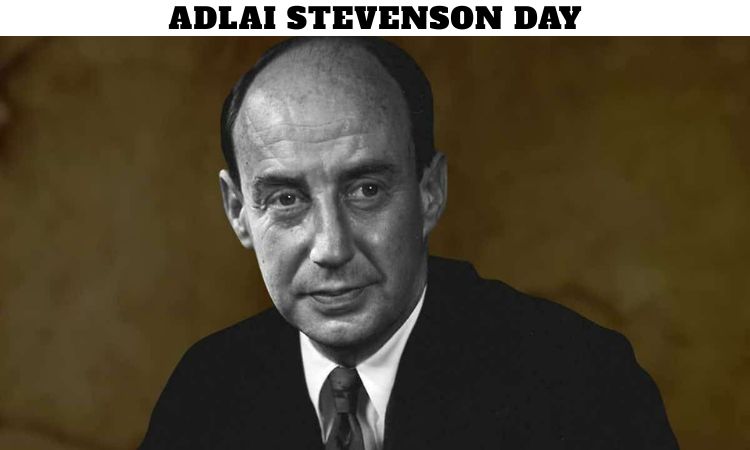
Adlai Stevenson Day, observed annually on February 5, is a meaningful occasion dedicated to remembering and honoring Adlai Ewing Stevenson II, one of the most influential American statesmen of the 20th century. We recognize this day as an opportunity to reflect on his enduring contributions to American politics, international diplomacy, democratic values, and intellectual leadership. His legacy continues to inspire generations who believe in reasoned debate, principled governance, and peaceful global cooperation.
This commemorative day is not only about honoring a historical figure but also about revisiting the ideals he championed—integrity in public service, respect for international law, and the power of eloquence and intellect in leadership.
Who Was Adlai Stevenson II?
Adlai Stevenson II was born on February 5, 1900, in Los Angeles, California, into a family deeply rooted in American political history. His grandfather, Adlai Stevenson I, served as Vice President of the United States, setting a foundation of public service that Stevenson II would carry forward with distinction.
Educated at Princeton University and Northwestern University School of Law, Stevenson quickly established himself as a brilliant legal mind, an articulate speaker, and a thoughtful leader. His intellectual depth and moral clarity distinguished him in an era often dominated by political theatrics.
Adlai Stevenson as Governor of Illinois
One of the most notable chapters of his career was his tenure as Governor of Illinois from 1949 to 1953. We regard this period as a defining moment in modern state governance. Stevenson implemented progressive reforms, modernized state institutions, fought corruption, and promoted transparency in government.
His governorship was marked by:
Judicial reform and ethical governance
Improved infrastructure and education
Commitment to civil liberties
Resistance to political patronage
These achievements earned him national recognition and established him as a leading voice within the Democratic Party.
Presidential Campaigns and National Influence
Adlai Stevenson was the Democratic Party’s presidential nominee in 1952 and 1956, running against Dwight D. Eisenhower. Although he did not win the presidency, his campaigns profoundly influenced American political discourse.
We remember his presidential bids for:
Intellectual honesty in campaigning
Clear articulation of policy positions
Respect for voters’ intelligence
Opposition to fear-based politics
His speeches emphasized diplomacy over militarism, social responsibility over unchecked power, and global cooperation over isolationism. These principles resonate strongly even today.
Adlai Stevenson at the United Nations
Perhaps Stevenson’s most globally impactful role was as U.S. Ambassador to the United Nations (1961–1965) under Presidents John F. Kennedy and Lyndon B. Johnson. In this position, he became an international symbol of calm resolve, diplomatic skill, and moral authority.
The Cuban Missile Crisis
One of the defining moments of his career occurred during the Cuban Missile Crisis in 1962. We recall his powerful and historic confrontation at the United Nations, where he presented photographic evidence of Soviet missiles in Cuba.
This moment demonstrated:
Courage under pressure
Mastery of diplomatic communication
Commitment to truth and global security
The power of reasoned argument over aggression
His actions helped avert nuclear catastrophe and solidified his reputation as a world-class diplomat.
Why February 5 Is Celebrated as Adlai Stevenson Day?
February 5, Stevenson’s birthday, was designated as Adlai Stevenson Day to ensure his contributions are remembered beyond textbooks. We observe this day to reaffirm the values he embodied—ethical leadership, respect for international institutions, and dedication to democratic ideals.
It is a day to:
Reflect on the importance of intellectual leadership
Promote peaceful conflict resolution
Encourage youth engagement in public service
Celebrate truth, civility, and moral courage
Adlai Stevenson’s Enduring Legacy
The legacy of Adlai Stevenson extends far beyond his lifetime. We continue to see his influence in modern diplomacy, political ethics, and public discourse. His belief that leaders should educate rather than manipulate remains a powerful reminder in an age of information overload.
Key Elements of His Legacy
Champion of diplomacy over war
Defender of democratic institutions
Advocate for international cooperation
Role model for ethical public service
Master of persuasive and principled communication
Stevenson proved that intelligence and integrity are not weaknesses in politics but strengths that can shape nations.
How is Adlai Stevenson Day observed?
Adlai Stevenson Day is observed through educational programs, political discussions, historical retrospectives, and civic activities. Schools, universities, and political organizations often use this day to explore his speeches, policies, and diplomatic achievements.
Common ways we observe this day include:
Reading and analyzing Stevenson’s speeches
Hosting panel discussions on diplomacy and ethics
Encouraging student debates on global issues
Sharing insights on peaceful international relations
These activities ensure that his ideas remain relevant and accessible to future generations.
Lessons We Learn from Adlai Stevenson
Adlai Stevenson Day reminds us that leadership grounded in wisdom, humility, and principle can leave a lasting impact. In a rapidly changing world, his approach to governance offers timeless lessons.
We learn that:
Words matter in shaping policy and peace
Diplomacy is a vital tool for global stability
Public service demands moral responsibility
Democracy thrives on informed citizens
Courage often lies in restraint, not force
Adlai Stevenson in Modern Context
In today’s geopolitical climate, Stevenson’s ideas feel remarkably contemporary. His emphasis on multilateral cooperation, international law, and respectful dialogue aligns closely with current global challenges such as climate change, nuclear non-proliferation, and human rights advocacy.
We continue to draw inspiration from his belief that global problems require collective solutions and that diplomacy remains humanity’s most powerful instrument for peace.
Conclusion: The Importance of Remembering Adlai Stevenson
As we observe Adlai Stevenson Day on February 5, we honor not just a man, but a set of ideals that remain essential to democratic societies worldwide. His life serves as a reminder that ethical leadership, intellectual rigor, and diplomatic courage can shape history without resorting to force.