

What Is Uruguay Independence Day?
Uruguay Independence Day is celebrated every year on August 25 as the country’s national day. Known in Spanish as Día de la Independencia, the holiday commemorates the declaration of independence made by Uruguay in 1825, when representatives of the eastern provinces formally rejected foreign rule and proclaimed their territory free and independent.
The day is one of the most important dates in Uruguay’s history. It represents the country’s long struggle for sovereignty and the determination of its people to establish an independent nation.
Uruguay’s independence was not achieved through a single event. Instead, it was the result of years of political conflict, military struggles, regional rivalries, and negotiations involving Uruguay, Brazil, Argentina, and other powers. August 25, 1825, is especially remembered because the representatives of the Eastern Province adopted a series of laws that declared independence and expressed their desire to become part of a larger union with the United Provinces of the Río de la Plata.
Today, Uruguay Independence Day is marked with public ceremonies, flags, cultural activities, historical commemorations, music, and gatherings with family and friends.
When Is Uruguay Independence Day Celebrated?
Uruguay Independence Day is celebrated on August 25 every year.
The date is a national public holiday in Uruguay, allowing people to participate in official ceremonies and community celebrations. Streets, public buildings, schools, businesses, and homes may display the Uruguayan flag during the national holiday period.
August 25 is particularly significant because it commemorates the events of August 25, 1825, when the representatives of the Eastern Province approved three important laws at the Florida Congress.
These laws are commonly remembered as the Declaration of Independence, the Law of Union, and the Law of Flags. Together, they represented a decisive political step toward the creation of an independent Uruguay.
Why Is August 25 Important to Uruguay?
August 25 is important because it symbolizes Uruguay’s determination to control its own political future.
Before independence, the territory that is now Uruguay was contested by different colonial and regional powers. The area was originally part of the Spanish colonial world, but it later became involved in conflicts between Portugal, Brazil, Spain, and the revolutionary forces of the Río de la Plata region.
In the early 19th century, José Gervasio Artigas became an important leader of the struggle for regional autonomy. His movement promoted political and economic ideas that influenced Uruguay’s later national identity.
After Artigas was defeated, the region was occupied by Portuguese forces and eventually incorporated into the United Kingdom of Portugal, Brazil and the Algarves. It later became known as the Cisplatine Province under the Empire of Brazil.
Resistance to Brazilian rule eventually produced another independence movement. On August 25, 1825, representatives meeting in Florida declared that the Eastern Province was free from Brazilian authority.
This event became one of the central foundations of Uruguay’s national story.
What Happened on August 25, 1825?
On August 25, 1825, representatives of the Eastern Province gathered in Florida, a town located in central Uruguay.
The assembly adopted three major laws. The first declared the province independent from Brazil and Portugal. The second expressed the province’s intention to unite with the United Provinces of the Río de la Plata. The third dealt with national symbols and the use of flags.
These decisions were made during a period of political and military conflict known as the Cisplatine War, fought between the Empire of Brazil and the United Provinces of the Río de la Plata, with the forces of the Eastern Province playing a major role.
The declaration did not immediately result in a completely independent Uruguay. Fighting and political negotiations continued for several years. However, August 25 became the symbolic date associated with Uruguay’s declaration of independence.
Who Played an Important Role in Uruguay’s Independence?
Several leaders and groups contributed to Uruguay’s path toward independence.
One of the most important figures was José Gervasio Artigas, who led the Banda Oriental’s revolutionary movement during the early 19th century. Although Artigas did not create the modern independent Uruguayan state, his political ideas and resistance to foreign domination became deeply connected with Uruguay’s national identity.
Another important figure was Juan Antonio Lavalleja, a military leader who helped organize the movement that challenged Brazilian control. In 1825, Lavalleja and his followers, known as the Thirty-Three Orientals, launched a campaign to liberate the Eastern Province.
The Florida Congress and its representatives were also central to the independence process. Their laws provided the political foundation for the movement and gave formal expression to the province’s desire for sovereignty.
The eventual creation of Uruguay also depended on international diplomacy. Britain played an important mediating role in the negotiations that eventually ended the conflict between Brazil and the United Provinces.
How Did Uruguay Finally Become an Independent Country?
The declaration of August 25, 1825, was an important milestone, but Uruguay’s complete independence came through a longer process.
After the declaration, the conflict between Brazil and the United Provinces continued. The war created political and economic difficulties for the region. Neither side was able to achieve a decisive and lasting victory.
Negotiations eventually resulted in the Preliminary Peace Convention of 1828. Under the agreement, Brazil and the United Provinces accepted the creation of an independent state in the territory of the Eastern Province.
Uruguay adopted its first constitution in 1830, providing a formal political framework for the new nation.
Therefore, August 25 should be understood as the date commemorating Uruguay’s declaration of independence, while the broader process of establishing the independent Uruguayan state continued through 1828 and beyond.
How Is Uruguay Independence Day Celebrated?
Uruguay Independence Day is generally celebrated through a combination of official ceremonies, cultural events, patriotic displays, and family gatherings.
Government officials may participate in ceremonies honoring the country’s independence leaders. Historical speeches, public events, musical performances, and flag ceremonies are common ways of recognizing the occasion.
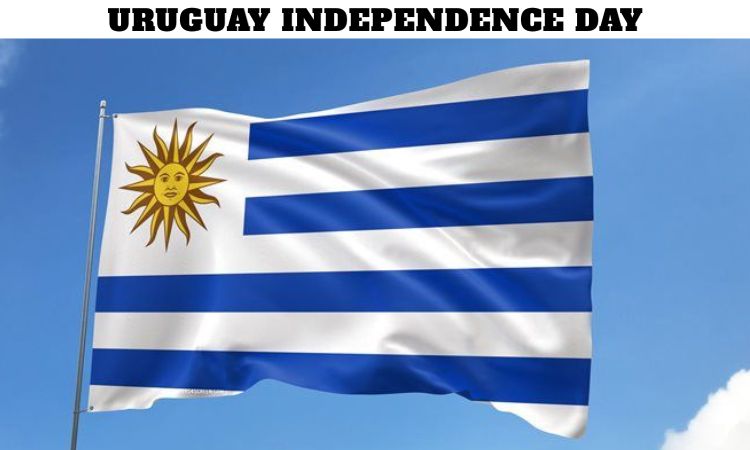
The national flag is an important part of the celebrations. The Flag of Uruguay, with its white and blue stripes and the Sun of May, is displayed prominently throughout the country.
Schools and cultural organizations may also organize activities that teach children and young people about Uruguay’s history. These events can include presentations, songs, historical performances, and discussions about national heritage.
For many people, the holiday is also an opportunity to spend time with family and enjoy traditional Uruguayan food and cultural activities.
What Are the National Symbols Associated With Uruguay Independence Day?
Uruguay has several important national symbols that are especially visible around Independence Day.
The national flag is perhaps the most recognizable. It features nine alternating horizontal blue and white stripes, representing the original nine departments of Uruguay, along with the Sun of May in the canton.
The Sun of May is also found on Uruguay’s national coat of arms and has historical connections with the independence movements of the Río de la Plata region.
The national anthem, “Himno Nacional de Uruguay,” is another important symbol. Written by Francisco Acuña de Figueroa, the anthem is performed during many official ceremonies.
José Artigas is also an important national symbol. His image, legacy, and political ideas occupy a major place in Uruguay’s historical memory.
What Can People Learn From Uruguay Independence Day?
Uruguay Independence Day offers important lessons about sovereignty, political identity, and national development.
The history of Uruguay shows that independence is often a gradual process rather than a single moment. The declaration of 1825 was followed by war, diplomacy, negotiations, and constitutional development before the modern Uruguayan state took shape.
The holiday also demonstrates how national identities can develop in complicated regional environments. Uruguay emerged between two major powers of South America, Brazil and Argentina, and its history was closely connected with both.
For Uruguayans, the day represents more than a historical declaration. It is a celebration of national identity and the development of an independent country with its own institutions, traditions, culture, and democratic history.
How Does Uruguay Independence Day Reflect Uruguayan Culture?
Independence Day provides an opportunity to celebrate Uruguay’s distinctive cultural heritage.
Uruguayan culture has been influenced by Indigenous traditions, Spanish colonial history, immigration, neighboring South American cultures, and the country’s own historical development.
Food is an important part of national celebrations. Asado, a traditional style of grilled meat, is strongly associated with Uruguayan social life. Mate is also deeply embedded in everyday culture and is commonly enjoyed in social settings.
Music and dance are another important part of national identity. Candombe, a musical tradition with African roots, holds an especially important place in Uruguayan culture and has been recognized internationally as part of the country’s cultural heritage.
Football is also deeply connected with Uruguay’s national identity. The country has a long and distinguished football history, and sporting achievements often become occasions for national pride.
Is Uruguay Independence Day a Public Holiday?
Yes. August 25 is observed as a national public holiday in Uruguay.
Government offices and many institutions close or operate under holiday schedules. The exact arrangements for businesses, transportation, tourist attractions, and other services can vary.
Because Independence Day is a major national occasion, public spaces may host ceremonies and cultural activities. Travelers visiting Uruguay around August 25 can expect to see national flags and patriotic displays throughout the country.
What Makes Uruguay’s Independence Story Unique?
Uruguay’s independence story is distinctive because the country emerged from a complex struggle involving several regional and international interests.
Unlike a straightforward conflict between a colony and a distant European power, Uruguay’s path to statehood involved Spain, Portugal, Brazil, the United Provinces of the Río de la Plata, local revolutionary leaders, and international diplomacy.
The territory was strategically important because of its location between the Río de la Plata and the Atlantic Ocean. Its geographic position contributed to centuries of competition over the region.
Uruguay eventually became an independent country partly because the creation of a separate state provided a diplomatic solution to the conflict between Brazil and the United Provinces.
This complicated history makes August 25 especially meaningful. It represents not only a declaration but also the beginning of the political process that ultimately established Uruguay as a sovereign nation.
How Can People Observe Uruguay Independence Day?
People can observe Uruguay Independence Day by learning about the country’s history, exploring Uruguayan culture, displaying the national flag, listening to traditional music, and learning about important historical figures.
Those living in Uruguay may attend public ceremonies, cultural programs, community events, or local celebrations.
People outside Uruguay can also recognize the occasion by exploring Uruguayan history and culture, preparing traditional foods, learning about the national symbols, or sharing information about the country’s independence.
For younger generations, the day can be an opportunity to understand how Uruguay developed its national identity and why August 25 remains an important date in its history.
What Does Uruguay Independence Day Mean Today?
Today, Uruguay Independence Day represents freedom, sovereignty, national identity, and the historical development of the Uruguayan state.
The holiday connects modern Uruguay with the events of 1825 and the generations of people who participated in the country’s political and military struggles.
While the historical circumstances surrounding independence were complex, the meaning of the holiday remains straightforward for many Uruguayans: it is a day to remember the country’s journey toward self-government and celebrate its identity as an independent nation.
August 25 therefore remains one of the most significant dates on Uruguay’s national calendar. It combines history, patriotism, culture, and remembrance while providing an opportunity for Uruguayans to celebrate their country’s past and look toward its future.
Frequently Asked Questions (FAQs)
1. When is Uruguay Independence Day celebrated?
Uruguay Independence Day is celebrated every year on August 25.
2. What does Uruguay Independence Day commemorate?
It commemorates the declaration made on August 25, 1825, when representatives of the Eastern Province declared independence from Brazilian and Portuguese rule.
3. Where was Uruguay’s independence declared?
The declaration was made in Florida, Uruguay, during the Florida Congress.
4. Who was José Gervasio Artigas?
José Gervasio Artigas was a major revolutionary leader in the Río de la Plata region and an important figure in Uruguay’s national historical identity.
5. Who were the Thirty-Three Orientals?
The Thirty-Three Orientals were a group of revolutionaries led by Juan Antonio Lavalleja who launched a campaign in 1825 against Brazilian control of the Eastern Province.
6. Did Uruguay become fully independent on August 25, 1825?
August 25 marks the declaration of independence, but the complete establishment of Uruguay as an independent state followed further conflict and diplomacy, particularly the 1828 Preliminary Peace Convention.
7. What is Uruguay’s national flag?
Uruguay’s flag has nine alternating blue and white stripes and features the Sun of May in the upper-left corner.
8. Is August 25 a public holiday in Uruguay?
Yes. August 25 is a major national public holiday in Uruguay.
9. What foods are associated with Uruguayan celebrations?
Asado is one of Uruguay’s best-known traditional foods and is commonly associated with social gatherings and celebrations.
10. Why is Uruguay Independence Day important?
The day is important because it commemorates a major step in Uruguay’s long journey toward sovereignty and celebrates the country’s national identity and historical heritage.