

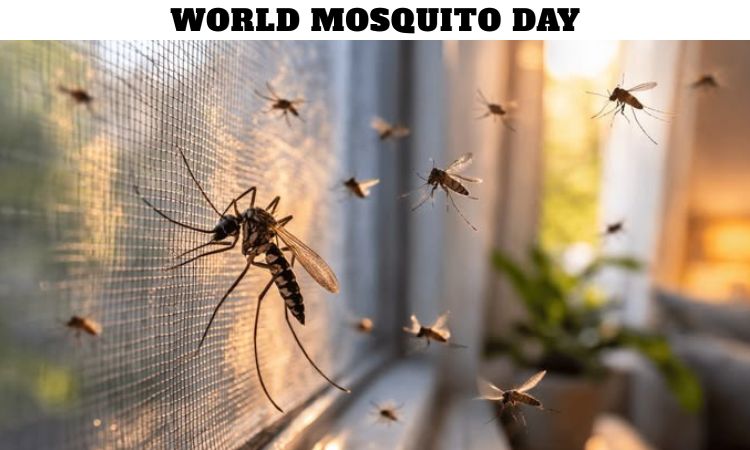
What Is World Mosquito Day?
World Mosquito Day is observed every year on August 20 to raise awareness about mosquitoes, the diseases they transmit, and the importance of preventing mosquito-borne illnesses. Although mosquitoes are tiny insects, they can have a major impact on public health because some species can transmit dangerous diseases from one person or animal to another.
The day also recognizes an important scientific discovery made by British physician and scientist Sir Ronald Ross in 1897. His research demonstrated that mosquitoes play a role in transmitting malaria. This discovery changed the understanding of malaria and helped establish the connection between mosquitoes and disease transmission.
World Mosquito Day provides an opportunity to learn more about mosquitoes, understand how mosquito-borne diseases spread, and encourage individuals, communities, health organizations, and governments to take preventive measures.
The observance is particularly relevant in tropical and subtropical regions, where mosquitoes can thrive because of warm temperatures, humidity, and suitable breeding environments.
Why Is World Mosquito Day Celebrated on August 20?
August 20 was selected because it marks the date of Ronald Ross’s important malaria-related discovery in 1897. Ross found evidence that mosquitoes could transmit malaria parasites between hosts.
His work was a major milestone in medical science. Before this discovery, the exact role of mosquitoes in malaria transmission was not fully understood. By establishing the mosquito’s role, scientists gained a better understanding of how malaria spreads and how mosquito control could help reduce transmission.
Ross later received the Nobel Prize in Physiology or Medicine in 1902 for his work on malaria.
World Mosquito Day therefore serves not simply as a day about mosquitoes, but as a reminder of how scientific research can transform public health. It also highlights the continuing need for research, disease surveillance, mosquito control, and public awareness.
Who Was Sir Ronald Ross?
Sir Ronald Ross was a British physician, researcher, and scientist who made significant contributions to the understanding of malaria. Born in 1857, he developed an interest in medicine and scientific research during his career.
While working in India, Ross investigated malaria and eventually established that mosquitoes were involved in transmitting the disease. His research helped demonstrate that the malaria parasite could be carried by mosquitoes and transmitted through their bites.
Ross’s discovery had long-term consequences for malaria prevention. It encouraged greater attention toward controlling mosquito populations and reducing human exposure to mosquito bites.
His work became an important foundation for later developments in tropical medicine and public health. Today, his contribution is remembered every year on August 20 through World Mosquito Day.
Why Are Mosquitoes Considered a Major Public Health Concern?
Mosquitoes are more than a nuisance because certain species can transmit pathogens responsible for serious diseases. They can spread diseases when they bite an infected host and subsequently transmit the pathogen to another host.
Some mosquito-borne diseases can cause mild symptoms, while others can result in severe illness and, in some circumstances, death. The risk varies depending on the mosquito species, pathogen, location, environmental conditions, and individual health factors.
Mosquitoes can also reproduce rapidly when suitable breeding conditions are available. Containers, discarded tires, blocked drains, buckets, flowerpots, and other places where stagnant water collects can become breeding sites for certain mosquito species.
Because mosquitoes can adapt to urban and rural environments, controlling them requires both individual precautions and community-level efforts.
Which Diseases Can Mosquitoes Spread?
Different mosquito species are associated with different diseases. Some of the better-known mosquito-borne diseases include malaria, dengue, chikungunya, yellow fever, Zika virus disease, West Nile virus disease, and Japanese encephalitis.
Malaria is caused by parasites of the Plasmodium genus and is transmitted by infected female Anopheles mosquitoes.
Dengue is caused by dengue viruses and is commonly transmitted by Aedes mosquitoes. Dengue can cause fever, headache, muscle and joint pain, and other symptoms. Severe dengue can become a medical emergency.
Chikungunya is another viral disease transmitted primarily by Aedes mosquitoes. It is particularly associated with fever and significant joint pain.
Yellow fever is a viral disease transmitted by infected mosquitoes in certain regions. Vaccination is an important preventive measure where recommended.
Zika virus can also be transmitted by mosquitoes and is particularly important because infection during pregnancy can cause serious complications for the developing fetus.
Japanese encephalitis and West Nile virus are additional examples of mosquito-borne diseases that can affect humans.
How Do Mosquitoes Spread Diseases?
Mosquitoes can spread disease through their feeding behavior. When certain female mosquitoes bite an infected person or animal, they may acquire a pathogen. The pathogen can then develop or multiply within the mosquito, depending on the disease.
When the infected mosquito later bites another suitable host, the pathogen may be transmitted through the mosquito’s saliva.
Not every mosquito carries disease, and not every mosquito species can transmit every disease. Disease transmission depends on a combination of mosquito species, pathogens, hosts, environmental conditions, and geographic factors.
Understanding this transmission cycle is important because it explains why mosquito control and personal protection can help reduce disease risk.
Why Is Mosquito Control Important?
Mosquito control is an important part of preventing mosquito-borne diseases. One of the simplest approaches is eliminating places where mosquitoes can breed.
Standing water should not be allowed to accumulate unnecessarily around homes, schools, workplaces, gardens, and public areas. Water containers should be emptied, cleaned, or properly covered where appropriate.
Community sanitation is equally important. Waste materials that can collect rainwater should be disposed of properly, and drainage systems should be maintained.
Depending on local conditions and public-health recommendations, mosquito-control programs may also use methods such as larval control, environmental management, mosquito surveillance, and carefully managed insecticide applications.
Mosquito control is most effective when individuals and communities work together rather than relying on a single method.
How Can People Protect Themselves From Mosquito Bites?
People can reduce mosquito exposure through several practical measures. Using an appropriate insect repellent, wearing long-sleeved clothing and long trousers, and using screens on doors and windows can help reduce bites.
Mosquito nets can provide additional protection, particularly for people sleeping in areas where mosquito exposure is significant.
Air conditioning, when available, can also reduce mosquito exposure because closed and cooled indoor environments are generally less favorable for mosquitoes.
It is also important to follow local public-health advice, particularly during outbreaks of mosquito-borne diseases.
Protection should not be limited to outdoor activities. Some mosquito species that transmit diseases are active around homes and can bite during the daytime as well as at other times.
How Can Families Reduce Mosquito Breeding Around Their Homes?
Families can make their surroundings less suitable for mosquitoes by regularly checking for standing water.
Buckets, plant saucers, discarded containers, children’s outdoor toys, old tires, clogged gutters, and other objects can collect rainwater. These items should be emptied, cleaned, covered, or removed when appropriate.
Water storage containers should be properly covered. Garden areas and drainage systems should also be checked regularly.
Even relatively small quantities of standing water can provide suitable breeding conditions for some mosquitoes. Regular household inspections can therefore be a simple but useful preventive habit.
Keeping surroundings clean does not eliminate every mosquito, but it can reduce potential breeding sites and complement other mosquito-control measures.
How Does Climate Affect Mosquito Populations?
Climate and environmental conditions can influence mosquito populations and disease transmission. Mosquitoes are strongly affected by temperature, rainfall, humidity, and the availability of water.
Warm conditions can accelerate mosquito development and, for some mosquito-borne pathogens, influence how quickly pathogens develop inside mosquitoes.
Heavy rainfall can create additional breeding sites, while water storage practices during dry periods can also provide opportunities for mosquito breeding.
Climate patterns can therefore influence where and when mosquito populations increase. However, the relationship between climate and disease transmission is complex and varies by mosquito species, pathogen, geography, and local environmental conditions.
Why Is Public Awareness Important on World Mosquito Day?
Public awareness is one of the most important goals of World Mosquito Day. People who understand how mosquitoes breed and transmit disease are more likely to take preventive action.
Awareness campaigns can encourage communities to remove standing water, use mosquito protection, recognize symptoms of mosquito-borne diseases, and seek appropriate medical care when necessary.
Schools can use the occasion to teach students about insects, disease prevention, environmental hygiene, and scientific discoveries. Communities can organize clean-up activities and educational campaigns.
World Mosquito Day also reminds people that preventing mosquito-borne diseases is not solely the responsibility of healthcare professionals. Everyday actions by households and communities can contribute to reducing mosquito breeding and exposure.
What Can Schools and Communities Do on World Mosquito Day?
Schools and community organizations can observe World Mosquito Day through educational activities. Students can learn about the mosquito life cycle, mosquito-borne diseases, and the history of Ronald Ross’s discovery.
Communities can conduct awareness campaigns, distribute educational materials, organize environmental clean-up activities, and encourage residents to check their surroundings for standing water.
Health professionals and local organizations can also use the day to explain preventive measures and promote awareness about symptoms that may require medical attention.
The goal should be practical education rather than fear. Mosquitoes are a natural part of many ecosystems, but controlling disease transmission requires informed and responsible action.
What Are Some Interesting Facts About Mosquitoes?
Mosquitoes belong to the insect order Diptera, meaning they are true flies. There are thousands of mosquito species worldwide, but only a portion are important vectors of human disease.
Female mosquitoes of many species require a blood meal to develop eggs, while male mosquitoes generally feed on plant-based sources such as nectar.
Mosquitoes have a complex life cycle that includes egg, larva, pupa, and adult stages. The immature stages are associated with water.
Not all mosquitoes bite humans, and not all mosquitoes transmit diseases. Disease transmission depends on specific mosquito-pathogen relationships.
The small size of mosquitoes makes their impact on public health especially remarkable. Their ability to reproduce and adapt to different environments makes mosquito surveillance and control important in many parts of the world.
How Can We Observe World Mosquito Day?
People can observe World Mosquito Day by learning about mosquito-borne diseases and sharing reliable prevention information with family and friends.
Households can use August 20 as a reminder to inspect their surroundings for standing water. Schools can organize educational sessions, while community groups can conduct clean-up campaigns.
People can also learn about the history of malaria research and Ronald Ross’s contribution to medicine. Understanding the scientific history behind the day makes the observance more meaningful.
Most importantly, World Mosquito Day should encourage year-round awareness. Mosquito prevention is not something that should happen only on August 20. Regular removal of breeding sites and appropriate personal protection can help reduce mosquito-related risks throughout the year.
Why Does World Mosquito Day Still Matter Today?
World Mosquito Day remains relevant because mosquito-borne diseases continue to affect populations around the world. Scientific advances have improved our understanding of mosquitoes, pathogens, disease transmission, diagnosis, treatment, and prevention, but mosquito control remains an important public-health challenge.
The day connects a historic scientific discovery with modern efforts to protect communities. It also demonstrates the importance of research in understanding diseases that can affect millions of people.
August 20 is therefore an opportunity to remember Ronald Ross’s contribution while focusing on the continuing importance of prevention, education, research, environmental management, and public-health cooperation.
By taking simple precautions, maintaining clean surroundings, and staying informed about local health recommendations, individuals can contribute to broader efforts to reduce mosquito-borne disease.
Frequently Asked Questions (FAQs)
1. When is World Mosquito Day observed?
World Mosquito Day is observed every year on August 20. The date commemorates Ronald Ross’s malaria-related discovery in 1897.
2. Why is World Mosquito Day celebrated?
World Mosquito Day is observed to raise awareness about mosquitoes, mosquito-borne diseases, prevention, and the scientific discovery that established the role of mosquitoes in malaria transmission.
3. Who discovered that mosquitoes transmit malaria?
Sir Ronald Ross demonstrated the role of mosquitoes in malaria transmission through his research in 1897. His work became an important milestone in malaria research.
4. What did Ronald Ross discover in 1897?
Ronald Ross demonstrated that mosquitoes were involved in transmitting malaria parasites. His discovery helped establish the mosquito’s role in the malaria transmission cycle.
5. Which diseases are spread by mosquitoes?
Mosquitoes can transmit diseases including malaria, dengue, chikungunya, yellow fever, Zika virus disease, West Nile virus disease, and Japanese encephalitis, depending on the mosquito species and geographic location.
6. How can mosquito bites be prevented?
People can reduce mosquito bites by using appropriate insect repellent, wearing protective clothing, using window and door screens, using mosquito nets where appropriate, and reducing exposure to mosquitoes.
7. How can mosquito breeding be reduced?
Mosquito breeding can be reduced by removing or managing standing water around homes and communities. Containers, discarded items, gutters, and other locations that collect water should be checked regularly.
8. Are all mosquitoes dangerous?
No. Most mosquito species do not transmit human diseases. Only certain species can act as vectors for particular pathogens.
9. What is the connection between malaria and World Mosquito Day?
World Mosquito Day commemorates Ronald Ross’s 1897 discovery that mosquitoes play a role in malaria transmission. His research changed the scientific understanding of malaria.
10. How can people observe World Mosquito Day?
People can observe World Mosquito Day by learning about mosquito-borne diseases, sharing prevention information, checking their surroundings for standing water, and participating in community awareness or clean-up activities.